
What Auschwitz Taught Me About Memory And Responsibility Student’s View: If Remembering Becomes Optional, History Becomes Fragile. But If Remembrance Is Active, It Becomes A Responsibility.
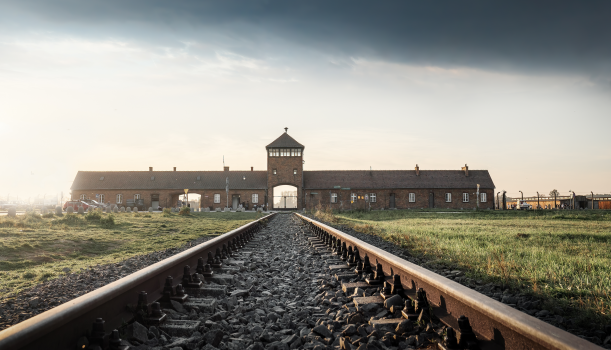
Railroad Track and the Gate of Death - Entrance of Auschwitz II - Birkenau, former German Nazi Concentration and Extermination Camp - Poland. (Shutterstock)
History depends on remembrance — not just remembering what happened but deciding what we are willing to confront and protect. When I was selected, along with seven other students from Success Academy high schools in New York City, to participate in a Holocaust Remembrance trip to Poland, I expected to learn history. What I didn’t expect was to leave questioning how remembrance actually works — and what it demands from us.
My first encounter was Auschwitz-Birkenau. Standing there, I realized how easily words like history and memory fail. The train tracks ran straight into the Nazi extermination camp and then simply stopped. Our guide said there was nowhere else to go. In New York City, trains mean movement: getting home, staying connected, continuing life. At Auschwitz, they carried people into death.
What stayed with me wasn’t just the scale of the violence but how deliberate it all was. About 80% of the people brought there were murdered within days, many immediately. The system was designed not only to kill, but to make killing efficient. That realization didn’t feel distant. It felt uncomfortably human.
As the trip continued, I began noticing how remembrance shows up — and how often it doesn’t. At the Galicia Jewish Museum in Krakow, I learned about a synagogue that had been destroyed during the Holocaust, rebuilt years later and repurposed as a toy store. That decision didn’t sit right with me. Synagogues are not just buildings; they are spaces of identity and connection. It raised a question I couldn’t shake: When historical spaces are restored, who decides how they are remembered — and what responsibility comes with that decision?
Later, in Warsaw, we visited what remains of the Jewish Ghetto and saw a mural honoring six members of the Jewish resistance who died after the Warsaw Ghetto Uprising. Their bravery gave hope to people who had almost none. Yet the mural honoring them wasn’t created until 2022 — nearly eighty years after their deaths. That delay troubled me. Remembrance shouldn’t have to wait decades to feel necessary.
As a Hispanic student who is not Jewish, this trip reshaped how I understand the Holocaust and its relevance today. I learned that antisemitism didn’t suddenly appear in the 1940s — it had deep roots, and difference was used as an excuse to exclude and dehumanize long before genocide followed. That pattern is not just “history.” It’s a warning.
People look different, worship differently, live differently. That diversity should never justify violence. And yet history shows how easily hatred grows when difference is normalized as a threat and memory is treated as optional.
This trip forced me to confront uncomfortable questions: Why did recognition take so long? Why are some stories remembered immediately while others fade? And what happens when remembrance becomes symbolic instead of intentional?
The 74: This commentary was first published by The 74. The 74 is a nonprofit news organization covering America’s education system from early childhood through college and career. There are 74 million reasons we need to talk about education every day. Join the conversation. Read the commentary at: https://www.the74million.org/article/what-auschwitz-taught-me-about-memory-and-responsibility/
Category:
User login


Omaha Daily Record
The Daily Record
222 South 72nd Street, Suite 302
Omaha, Nebraska
68114
United States
Tele (402) 345-1303
Fax (402) 345-2351
222 South 72nd Street, Suite 302 | Omaha, Nebraska 68114 | United States | Tele (402) 345-1303 | Fax (402) 345-2351 | Sitemap
