
USDA’s Finalized Rule Could Boost Adoption Of Regenerative Farming Practices
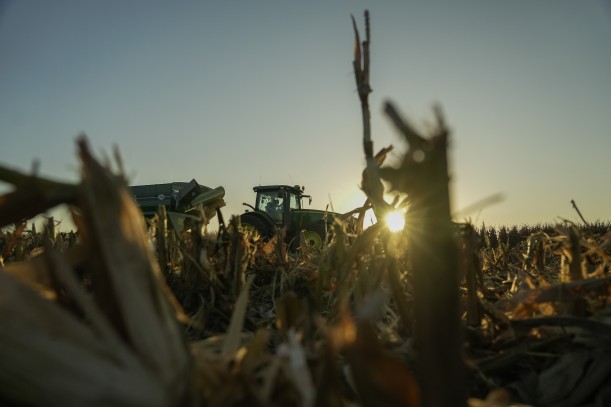
A combine harvests corn, Tuesday, Oct. 10, 2023, at a farm near Allerton, Ill. Cover crops top the list of tasks U.S. farmers are told will build healthy soil, help the environment and fight climate change. Yet after years of incentives and encouragement, Midwest farmers planted cover crops on only about 7% of their land in 2021. (Joshua A. Bickel / AP Photo)
Farmers growing corn and soybeans for biofuels can now quantify the carbon intensity of crops grown with certain regenerative agriculture practices, due to a recently finalized federal rule.
The U.S. Department of Agriculture’s Regenerative Feedstock Rule will allow farmers to “capture new value” from agricultural practices like cover crops and reduced tillage, according to a news release from the department.
According to the finalized rule, the production of corn accounts for more than 50% of the direct greenhouse gas emissions associated with producing corn ethanol, and nearly 50% of soybean biodiesel emissions are attributable to the feedstock crop production.
The greenhouse gas emissions associated with growing corn and soybeans can be reduced with the “low-carbon practices” outlined in the final rule. These tools include reduced tillage, cover crops and nitrification inhibitors.
Farmers can also lower the carbon intensity score of a feedstock by following nutrient management guidelines that specify nutrient budgets based on current soil testing and are verified by a third party.
According to the final rule, these practices, which in earlier iterations of proposed rules were called “climate-smart agriculture” practices, generally reduce greenhouse gas emissions or increase soil-carbon sequestration. The adoption of these practices can lower the greenhouse gas emissions of biofuel production and “provide other environmental benefits” like improved water quality and soil health, according to the final rule.
Along with the finalized rule, USDA released an updated carbon intensity calculator to help farmers “quantify regenerative practices” and market their feedstocks accordingly.
The carbon intensity score of a feedstock is important to low-carbon biofuel producers, as these fuels must be produced within certain total greenhouse gas emissions limits – from the field to distillation. Low-carbon intensity feedstocks can help biofuel producers fit within these limits.
The finalized rule was celebrated by crop and biofuel groups in Iowa, who also called for the adoption of the rule into a U.S. Department of Energy model essential to receiving low-carbon fuel tax credits known as 45Z tax credits.
The renewable fuels industry has also looked to carbon sequestration pipelines as a way to lower the life cycle greenhouse gas emissions of biofuels, but such projects have faced pushback in Iowa.
Iowa Renewable Fuels Association Executive Director Monte Shaw called the finalization of the USDA rule a “great step forward” and said farmers can benefit from adopting regenerative practices, while biofuels producers will be able to source low-carbon intensity feedstocks and access “massive new markets.”
“And maybe most importantly, biofuels production will now be the single biggest driver of regenerative ag practices that improve water quality throughout rural America,” Shaw said in a news release.
Shaw said the DOE needs to “expeditiously” incorporate the USDA tool into the Greenhouse gases, Regulated Emissions, and Energy use in Technologies, or GREET, model that stipulates the life cycle emissions levels a biofuel must be produced within to qualify for the 45Z tax credit.
“The Treasury Department must immediately recognize that updated model in time for farmers to make decisions this fall,” Shaw said. “It may seem a little early when this year’s harvest isn’t even out of the ground yet, but many farmers will already be making decisions by August that will impact the (carbon intensity) of next year’s crop.”
Mark Mueller, president of the Iowa Corn Growers Association, said the new rule will “jumpstart” opportunities for growers in Iowa who “are committed to doing what’s right for the land and the environment.”
“For years, Iowa corn farmers have led the nation in adoption and implementation of conservation practices, and today’s USDA rule provides a framework to reward conservation-minded farmers who are stewards of the land,” Mueller said in a news release.
President Donald Trump also signed an executive order Friday calling for the advancement of regenerative agriculture practices. The order connects the practices to the administration’s Make America Healthy Again initiative.
“It is the policy of the United States to promote continued advances in precision agriculture technologies; significantly increase Federal investment in regenerative agriculture practices, research, and education; and spur private-sector innovation in farm modernization by reducing red tape and strengthening public-private partnerships,” the order said.
In addition to regenerative agriculture practices, the order also urged the U.S. Environmental Protection Agency to prioritize the registration of substances that can be used as alternatives to “older active ingredients.” It also encouraged EPA to support research into the impacts of chemical exposures on human health.
A news release from USDA said the executive order and finalized rule represent the “most significant market-driven effort ever undertaken to reward America’s farmers for voluntarily implementing regenerative practices.”
Secretary of Agriculture Brooke Rollins said the initiatives were examples of Trump’s “America First agenda.”
“(The rule) put farmers, not Washington bureaucrats, in the driver’s seat,” Rollins said in the release. “Instead of mandates, we’re creating market opportunities. Farmers who choose to implement regenerative practices will have new opportunities to earn premium prices, lower their input costs, improve soil health, and strengthen the long-term profitability of their operations.”
Regenerative Practices
Cover crops: seeding a crop between cash crops, can help to keep roots and nutrients in the soil.
Reduced tillage or no till: tilling a field in strips, or not at all, helps to keep the carbon dioxide sequestered by growing plants, and other nutrients, in the soil.
Nitrification inhibitor: adding a nitrification inhibitor to fertilizer slows the conversion of ammonia to nitrate in the soil and can reduce nitrous oxide emissions.
This story was originally produced by Iowa Capital Dispatch, which is part of States Newsroom, a nonprofit news network which includes Nebraska Examiner, and is supported by grants and a coalition of donors as a 501c(3) public charity. Read the article here: https://nebraskaexaminer.com/2026/07/06/repub/usdas-finalized-rule-could-boost-adoption-of-regenerative-farming-practices/
Category:
User login


Omaha Daily Record
The Daily Record
222 South 72nd Street, Suite 302
Omaha, Nebraska
68114
United States
Tele (402) 345-1303
Fax (402) 345-2351
222 South 72nd Street, Suite 302 | Omaha, Nebraska 68114 | United States | Tele (402) 345-1303 | Fax (402) 345-2351 | Sitemap
